
The History of the Adal Empire
Origins of the Empire
It was in the 13th century that one of the strongest empires ever to exist in East Africa came to light in the Horn of Africa. The Adal Empire had its origin in the city of Zeila, situated to this day in the northern region of the former Democratic Republic of Somalia. The father of that State was King Omar D. Ahmed (nicknamed Aw-Barkhadle). The king, who had a long life, occupied the throne for many years. When he passed away, he left behind him many children, mainly males, among them the successors who inherited the kingdom. Later, the Adal Empire became an Islamic empire that spread the religion of Islam with determination throughout the Horn of Africa.
Structure and States of Adal
The Adal Empire was composed of seven (7) States. Ranked by the size of their land and military forces, they were: Ifaad, Dawaaro, Araabiini, Hadaya, Sharqa, Baali and Daara, each of which had its own government. The largest and strongest State, Ifaad, known in Egypt and the Levant (“Shaam”) as the land of Zeila, later became the dominant and central one, with Zeila as its capital city. Ifaad would lead the entire Empire and face many challenges. According to the historians of that period, Ifaad measured 20 days’ walk from north to south and 15 days’ walk from east to west. Its military force was composed of 15,000 cavalry and 20,000 infantry.
In his book “Masaalikal-Absaar” (Masalik al-Absar; this is the Somali spelling), the 14th-century scholar Ibn Fadlallah al-Umari, who served the Mamluk court in Cairo, mentioned that Zeila was the nucleus city of the Adal Empire. His account was later repeated by the Egyptian scholar al-Qalqashandi in his encyclopaedia “Subh al-A‘sha”. Continuing his description of the city, he added that Zeila was “The City of Light”, with many mosques and many schools where all kinds of subjects were taught. In fact, al-Umari described Zeila as “The Place” where one could acquire any kind of knowledge taught in that period. The author added that the people were 100% Muslim, and that they gathered in large numbers in the mosques of the city as faithful believers in Islam. According to this writing, these mosques could be compared to the municipal libraries found today in the big cities of our century. In addition, the schools were places where people enjoyed meeting, sharing knowledge, discussing social issues and debating intellectually. As a matter of fact, Zeila was known as the place where knowledge was within everyone’s reach.
Recognising its faithfulness, other Islamic States in the world called the Adal Empire “Diraasal-Islaam”.
The Walashma Dynasty
The Walashma dynasty was a Muslim noble family who ruled parts of what is now eastern Ethiopia, Djibouti, southern Eritrea and western Somalia. The earliest known member of this family was Umar ibn Dunya-huz (died 1275), whose son Ali ibn Wali Ashma conquered the Muslim kingdom of Shewa.
- Haqq ad-Din I
- Sabr ad-Din I
- Jamal ad-Din I
- Ali ibn Sabr ad-Din
- Ahmad ibn Ali
- Haqq ad-Din II
- Sa’ad ad-Din II
- Sabr ad-Din II
- Mansur ad-Din
- Jamal ad-Din II
- Badlay ibn Sa’ad ad-Din
- Muhammad ibn Badlay
- Shams ad-Din ibn Muhammad
- Muhammad ibn Azhar ad-Din
- Abu Bakr ibn Muhammad
- Umar Din
- Ali ibn Umar Din
- Barakat ibn Umar Din
Muslim-Christian relations soured during the reign of the aggressive Negus Yeshaq (ruled 1414–1429). Forces of his rapidly expanding empire descended from the highlands to despoil Muslim settlements in the valley east of the ancient city of Harar. Having branded the Muslims “enemies of the Lord”, Yeshaq invaded the Muslim Kingdom of Ifat in 1415. He crushed the armies of Ifat and put Ifat’s king, Sa’ad ad-Din, to flight in the wastes along the Gulf of Tadjoura (in present-day Djibouti). Yeshaq followed Sa’ad ad-Din to the island off the coast of Zeila (which still bears his name), where the Muslim king was killed. Yeshaq compelled the Muslims to pay tribute, and also ordered his singers to compose a gloating hymn of thanksgiving for his victory. In the hymn’s lyrics, the word Somali appears for the first time in the written record.
A century later, the Muslims had recovered sufficiently to break through from the east into the central Ethiopian highlands, led by the charismatic Imam Ahmad Guray (c. 1506–1543).
The Rise of Imam Ahmad Guray
Ahmad ibn Ibrahim al-Ghazi (c. 1506 – February 21, 1543) was a Somali imam and general who defeated several Ethiopian emperors and wreaked much damage on that nation. He is also known as Ahmad Gragn (or Gurey), “Ahmed the left-handed”.
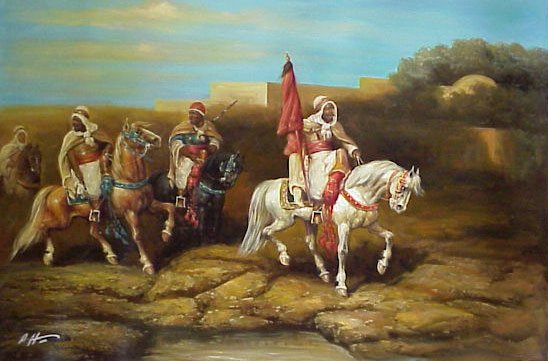
He was born near Zeila, a port city in northwestern Somalia, and married Bati del Wambara, the daughter of Governor Mahfuz of Zeila.
When Mahfuz was killed returning from a campaign against the Ethiopian emperor Lebna Dengel in 1517, the Adal Sultanate lapsed into anarchy for several years, until Imam Ahmad killed the last of the contenders for power and took control of Harar.
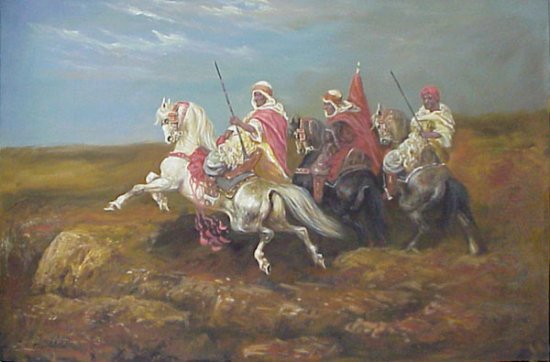
In retaliation for an attack on Adal in 1527–28 by the Ethiopian general Degalhan, Imam Ahmad invaded Ethiopia in 1529. Although his troops feared their opponents and tried to desert on hearing that the Ethiopian army was approaching, Imam Ahmad relied on his elite company armed with matchlocks, and defeated Emperor Lebna Dengel at Shimbra Kure that March.
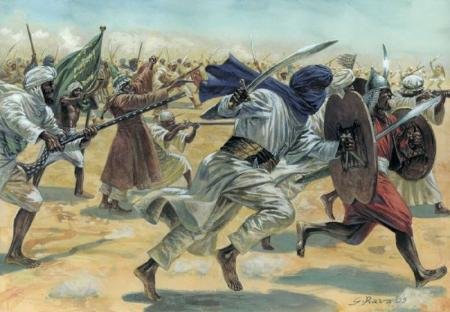
Imam Ahmad campaigned again in Ethiopia in 1531, breaking Emperor Lebna Dengel’s ability to resist at the Battle of Amba Sel on October 28, then marched north to loot the island monastery of Lake Hayq and the stone churches of Lalibela. When the Imam entered the province of Tigray, he defeated an Ethiopian army that confronted him there, and on reaching Axum destroyed the Church of Our Lady Mary of Zion, where the Ethiopian emperors had been crowned for centuries.
Adal and the Ottoman Empire
The Adal Empire had robust commercial and political relations with the Ottoman Empire. The Ottoman Turks, themselves actively engaged in wars against European kingdoms, did not pay much attention to Ethiopia.
Things changed when the Portuguese reached the Ethiopian court: the envoy Pêro da Covilhã arrived in the early 1490s, and in 1520 Emperor Lebna Dengel received an official Portuguese embassy.
However, the Emperor did not see much advantage in befriending the Portuguese, nor how he could form an alliance that would benefit Ethiopia. The Portuguese had two motives: 1) to spread Catholicism, and 2) to form an alliance with this mysterious and powerful Christian empire, which they hoped would eventually enable them to fight the Turks. The visit of the Portuguese did not go unnoticed by the Turks, who were promptly informed by their spies in Denkaz.
The Turks, who were in contact with Adal, found Gragn to be a formidable military leader with a fanatical zeal for Islam. They made a deal with Gragn: he was to subjugate the Christian empire and convert it to Islam, while they would thwart any possible alliance between Ethiopia and Europe, which would have dangerously outflanked the Turks in the Indian Ocean.
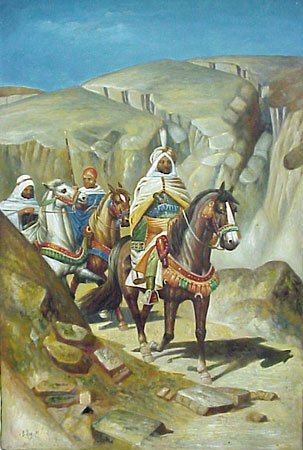
The Turks provided Adal and Gragn with 900 bombardiers, or what today’s military terminology would call artillerymen. The war was, needless to say, a disaster for Ethiopia. The Ethiopians were armed only with swords and spears, while their enemies had guns and experienced Turkish troops under their command.
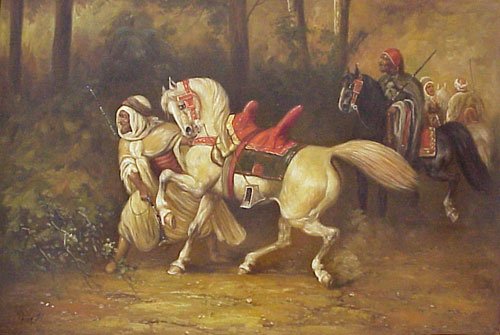
The King of Adal marched out of his trenches to enter those of the Portuguese. Mohammed’s forces entered the camp and put the Christians to the spear. The Portuguese general (Christopher) escaped the slaughter with ten men and retreated to a wood, where they were discovered… (and killed).
… Mohammed Gragne improved his victory by chasing the young Claudius (king of Ethiopia) over Abyssinia, where nothing opposed the progress of his arms. At last the few Portuguese survivors repaired to the Christian Emperor, who was persuaded to march an army against the King of Adel (Mohammed Gragne). Resolved to revenge their general, the harquebusiers demanded the post opposite Mohammed, and directed all their efforts against the part where the Moslem stood. His fellow religionists still relate that when Gragne fell in action, his wife Talwambara, the heroic daughter of Mohfuz, to prevent the destruction and dispersion of the host of al-Islam, buried the corpse privately, and caused a slave to personate the King, until a retreat to safe lands enabled her to discover the stratagem to the noble.
Thus, after a 30-year jihad, the King of Adal perished. Mohammed was succeeded on the throne of Adel by Amir Nur ibn Mujahid, and, according to some, brother to the ‘left-handed’. He proposed marriage to Talwambara, who accepted him on condition that he should lay the head of the Emperor Claudius at her feet. In AD 1559, he (Amir Nur) sent a message of defiance to the Negush (Ethiopian Emperor Claudius), who, having saved Abyssinia almost by a miracle, was rebuilding on Debra Work, the ‘Golden Mount’, a celebrated structure which had been burned by the Muslims. Claudius, despising the eclipses, evil prophecies and portents which accompanied his enemy’s progress, accepted the challenge. Claudius was supported by a handful of Portuguese, who were soon slain around him, and he fell covered with wounds.
Amir Nur cut off his head and laid it at the feet of Talwambara, who, in observance of her pledge, became his wife. Talwambara suspended the trophy by its hair from the branch of a tree opposite her abode, that her eyes might be gladdened by the sight; after hanging for two years, it was purchased by an Armenian merchant, who interred it in the sepulchre of St. Claudius at Antioch.
The untimely death of Mohammad Gragne was a very great blow to the Somalis. His wife and her new husband Amir Nur continued fighting the Ethiopians for seven years, but they were in fact pushed back from the central highlands of Shewa, where Addis Ababa stands today, to the border near the Haiwaish (‘Awash’) river because of Portuguese help to the Ethiopian guerrillas.
After seven years of fighting, Amir Nur and his wife withdrew to their former headquarters at Harar, and Harar again became the principal Somali city. When she died, her son Amir Abdullahi succeeded. His dynasty ruled Harar until 1884.
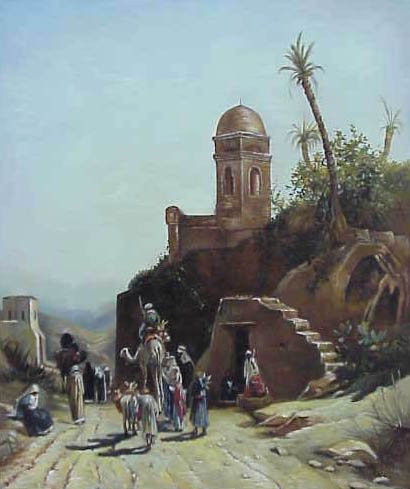
In the 17th century, the Adal Empire became a protectorate of the Ottoman Empire, ruled by local Somali chiefs.
Legacy and Cultural Influence
After Imam Ahmad’s death in 1543, his widow Bati del Wambara and his successor Amir Nur ibn Mujahid continued the struggle, keeping Harar as the cultural and political capital.
The dynasty of Harar continued to rule until 1884, leaving behind an enduring legacy of education, architecture, faith, and unity.
Today, the influence of the Adal Empire is still visible across Awdal, Zeila, Harar, and Djibouti, where traditions of scholarship, trade, and diplomacy trace their roots back to this powerful Islamic civilization.
Historical Maps
Below is a historical depiction of the Horn of Africa showing Adal territories during the Empire’s height:
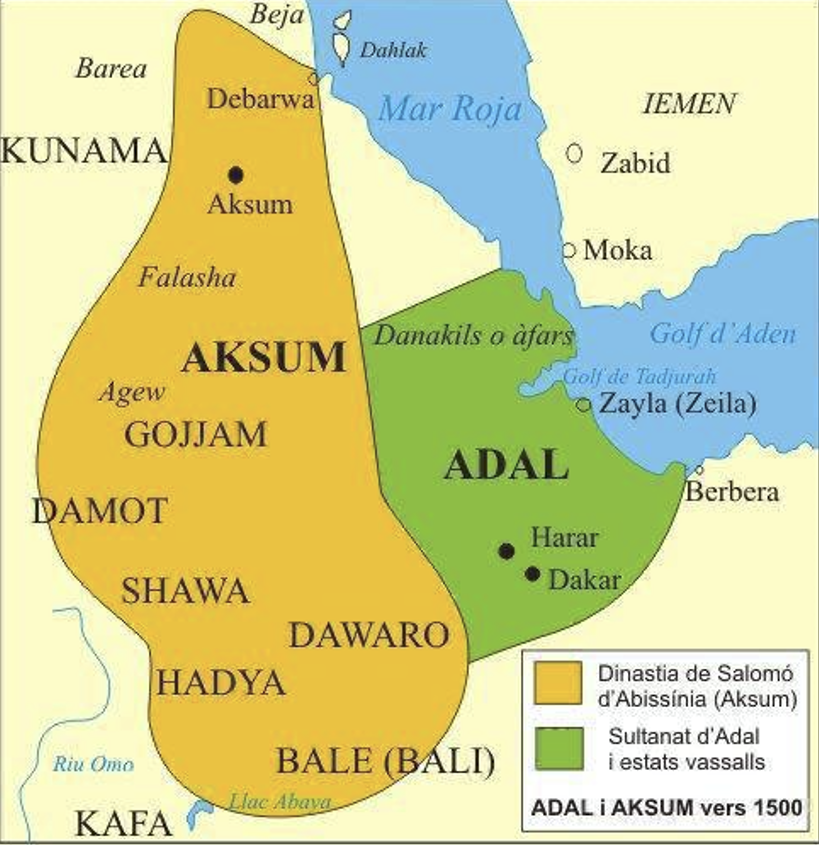
Map Description: The Adal Empire and Its Somali Foundations
This historical map depicts the Horn of Africa around the year 1500, when the Adal Empire reached its greatest territorial expansion.
Shown in green, the Empire stretched from the Red Sea coast at Zeila and Berbera, across Harar and Dakar, to the highlands bordering the Christian Abyssinian (Aksumite) kingdom in the west.
The map clearly distinguishes the two major powers of the region:
- the Adal Sultanate, representing the Muslim states of the Somali coast and lowlands, and
- the Abyssinian Empire (Aksum), a Christian highland kingdom.
The frontier between Adal and Aksum — marked here near the regions of Dawaro, Hadya, and Bale (Bali) — was a dynamic zone of trade, diplomacy, and conflict.
It was along this frontier that the Adal armies, led by the Walashma dynasty and later by Imam Ahmad Guray, defended the independence of the Muslim states and expanded their influence into the Ethiopian plateau.
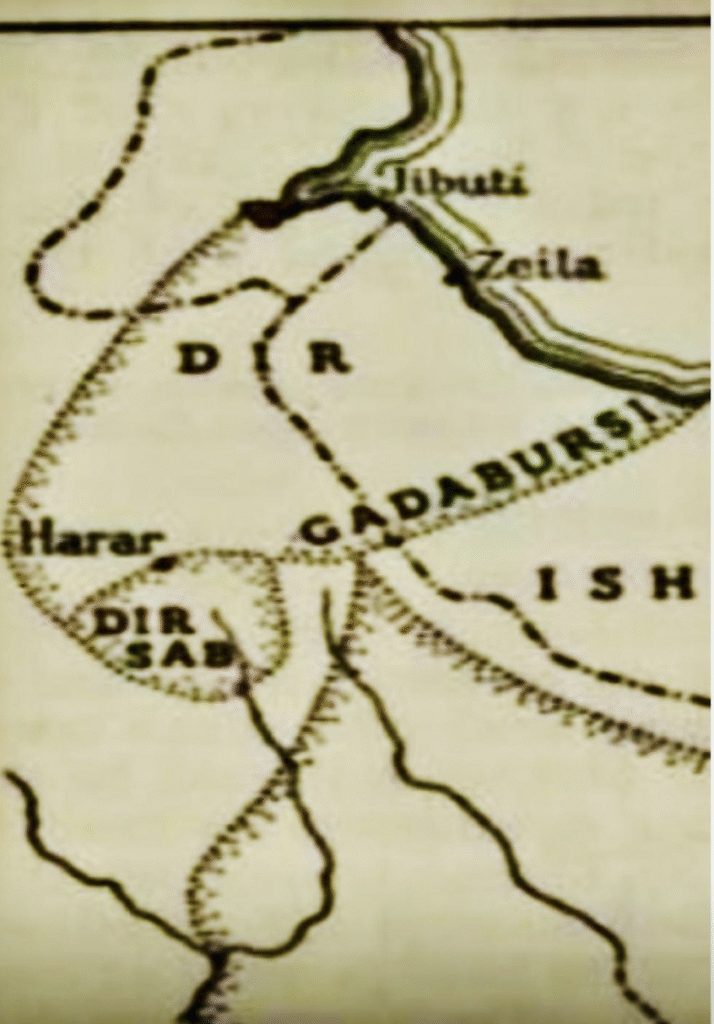
At the heart of Adal’s strength were the Somali clans, particularly the Gadabursi (Gadabuursi), who inhabited the region between Zeila, Harar, and Djibouti — the same area marked on older ethnographic maps as part of the Dir confederation.
The Gadabursi sultans and elders were among the key founders and administrators of the Empire.
Their port city of Zeila served as the political and commercial capital of Adal and as a gateway linking Africa to Arabia, Egypt, and the Indian Ocean trade routes.
Under Gadabursi leadership, Zeila became renowned for its scholarship, mosques, and open intellectual life — earning the title “The City of Light” in medieval Islamic writings.
From this base, Gadabursi rulers maintained the balance between the coastal trade networks and the interior highlands, ensuring the Empire’s prosperity and its enduring legacy as one of the most sophisticated Muslim civilizations of East Africa.
Map Description: Peoples of the Horn of Africa (Historical Context)
This historical map, titled “Peoples of the Horn of Africa,” illustrates the traditional territories of major Somali and Cushitic groups before the colonial period.
In the northwestern region — stretching from Zeila to the highlands near Harar — lies the Gadabursi (Gadabuursi) territory, identified here as part of the broader Dir family.
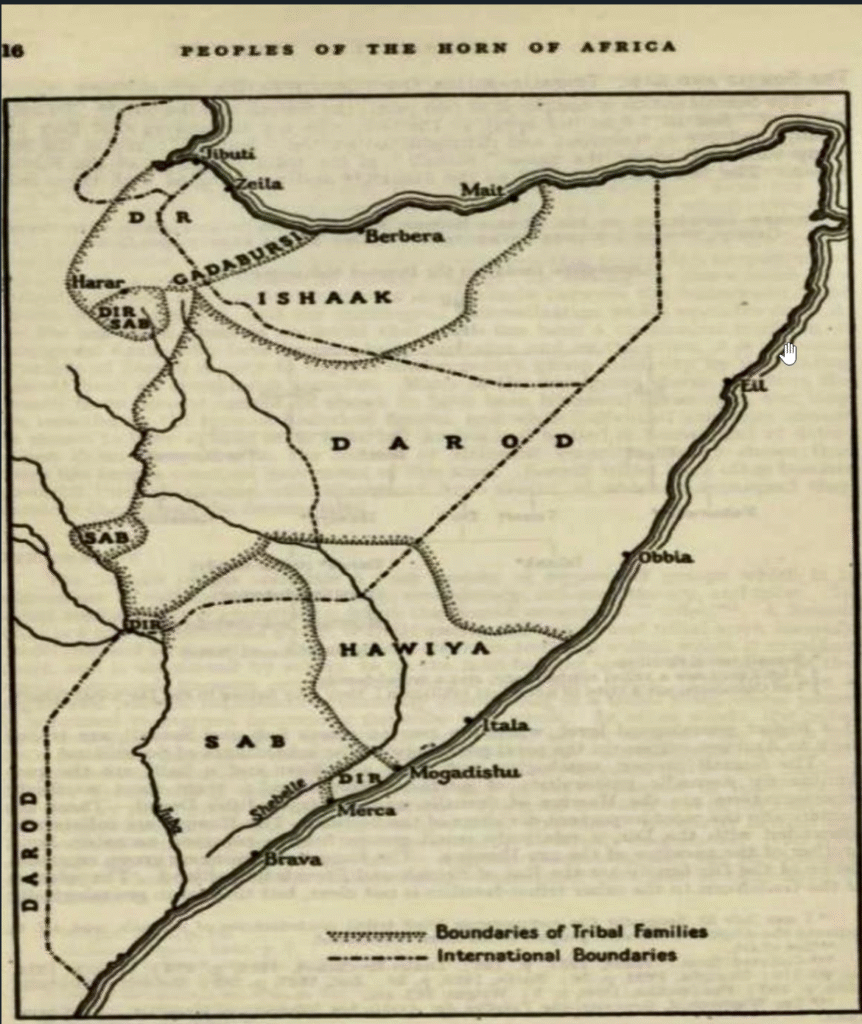
During the height of the Adal Empire (13th–16th centuries), the Gadabursi were one of the dominant clans and principal power bases of the Empire.
Their stronghold around Zeila and Harar formed the political and commercial heart of Adal, connecting coastal trade with the interior highlands.
Gadabursi rulers, nobles, and scholars played a key role in:
- governing the western provinces of the Empire,
- supporting the Walashma Dynasty, and
- leading the spread of Islam, education, and cross-regional diplomacy across the Horn of Africa.
From Zeila, the Empire’s early capital, Gadabursi leaders maintained control of trade routes linking the Red Sea, Harar, and the Ethiopian plateau, ensuring Adal’s influence endured for centuries.
Even after the fall of the Empire, Gadabursi communities continued to preserve this legacy of statecraft and scholarship, marking them as direct heirs of Adal’s cultural and historical heritage.